Abstract
-
Purpose
The use of adhesive-pad stabilization devices (SDs) instead of suture fixation (SF) may affect dislocation or infection rates. This study aimed to investigate the impact of SDs compared with SF for securing central venous catheters (CVCs).
-
Materials and Methods
This multicenter retrospective study was conducted in three tertiary institutions. Two institutions secured CVCs using sutures, whereas one used SDs, between February 2021 and July 2022. Rates of inadvertent dislocation and central line–associated bloodstream infection (CLABSI) were compared using incidence rate ratios (IRRs) from Poisson regression and Kaplan-Meier analysis after propensity-score matching. Factors associated with dislocation and CLABSI were evaluated using Cox proportional hazards analysis.
-
Results
A total of 2,110 patients (1,045 female; median age, 61 years [IQR, 50 to 72]) underwent CVC placement (SD, 854; SF, 1,256). After propensity-score matching (455 SD, 666 SF), dislocation occurred more frequently in the SD group (5.85 vs. 2.17 per 1,000 catheter-days; IRR, 2.64; 95% CI, 1.36 to 5.34). CLABSI occurred less frequently in the SD group (IRR, 0.19; 95% CI, 0.04 to 0.54). Kaplan-Meier analysis showed similar results. In multivariable analysis, SD was an independent risk factor for dislocation (adjusted HR [aHR], 2.23; 95% CI, 1.11 to 4.48). SD use showed a protective trend against CLABSI but did not reach statistical significance (aHR, 0.49; 95% CI, 0.13 to 1.82). When dislocation was modeled as a competing event, this protective association reached statistical significance (subdistribution HR, 0.19; 95% CI, 0.05 to 0.66).
-
Conclusion
Securement of CVCs with SDs was associated with a higher rate of catheter dislocation. Although SD use was associated with lower CLABSI rates, this finding requires further validation.
-
Keywords: Central venous catheters; Equipment failure; Bloodstream infection; Dislodgement; Accidental catheter removal
Introduction
A central venous catheter (CVC) plays an essential role in contemporary medicine as a route for fluid therapy and patient monitoring [
1]. Maintaining CVC placement for the requested duration is important for patient treatment, particularly in those with limited venous access. Conventionally, catheter hubs or clamps were sutured into the subcutaneous layer to prevent inadvertent dislocation. However, adhesive-pad stabilization devices (SDs) have been recently developed and are increasingly used. These devices secure the hub or clamp with adhesive wings rather than sutures, offering advantages such as reduced pain, shorter application time, and less tissue injury upon removal. A notable limitation of SDs is that they may be more prone to catheter dislocation. Several studies have reported conflicting results regarding suture versus SD fixation [
2,
3]. The Infusion Nurses Society Infusion Therapy Standards of Practice recommend avoiding sutures, noting that they are associated with needlestick injuries, biofilm formation, and an increased risk of central line–associated bloodstream infection (CLABSI) [
4]. This study aimed to compare dislocation and CLABSI rates between SD and suture fixation (SF) in patients with centrally or femorally inserted central catheters (CICC/FICC) using a multicenter, propensity score–matched cohort.
Materials and Methods
Patients
This multicenter retrospective study used data from a previously published study, which was approved by the institutional review board of each participating institution (Incheon Saint Mary’s Hospital [No. OC23RIDI0050], Ajou University Hospital [No. AJOUIRB-DB-2024-474], and Seoul National University Bundang Hospital [No. B-2306-836-101]); the data are available to investigators upon reasonable request [
5]. The requirement for informed consent was waived due to the study’s retrospective nature. The previous study was a before-and-after study evaluating the effect of tissue adhesive on CVC exit-site infection. In this secondary analysis, patients were regrouped by catheter fixation method according to institutional practice, as each institution consistently used either SF or SD throughout the study period. Two institutions secured CVCs by suturing the hub, and one institution fixed the hub or clamp with an SD (StatLock, BD, Franklin Lakes, NJ, USA).
The study retrospectively collected data from patients who underwent CICC or FICC from February 2021 to July 2022, including demographics, comorbidities, purpose of catheterization (medical or surgical), use of tissue adhesive at the exit site, ICU stay, catheterization duration in days, laterality (right or left), number of previous catheterizations, and access site (jugular, subclavian, or femoral). Patients under 19 years of age, outpatients, or those undergoing central line exchange were excluded. The unit of analysis was the catheter episode. In patients who underwent multiple catheterizations, each episode was treated as an independent observation. Electronic case report forms were completed by reviewing daily nursing charts and documenting any inadvertent dislocation, including total dislodgement or partial withdrawal of CVCs. Owing to imbalance between institutional practices, a propensity score–matched dataset was established.
Procedures
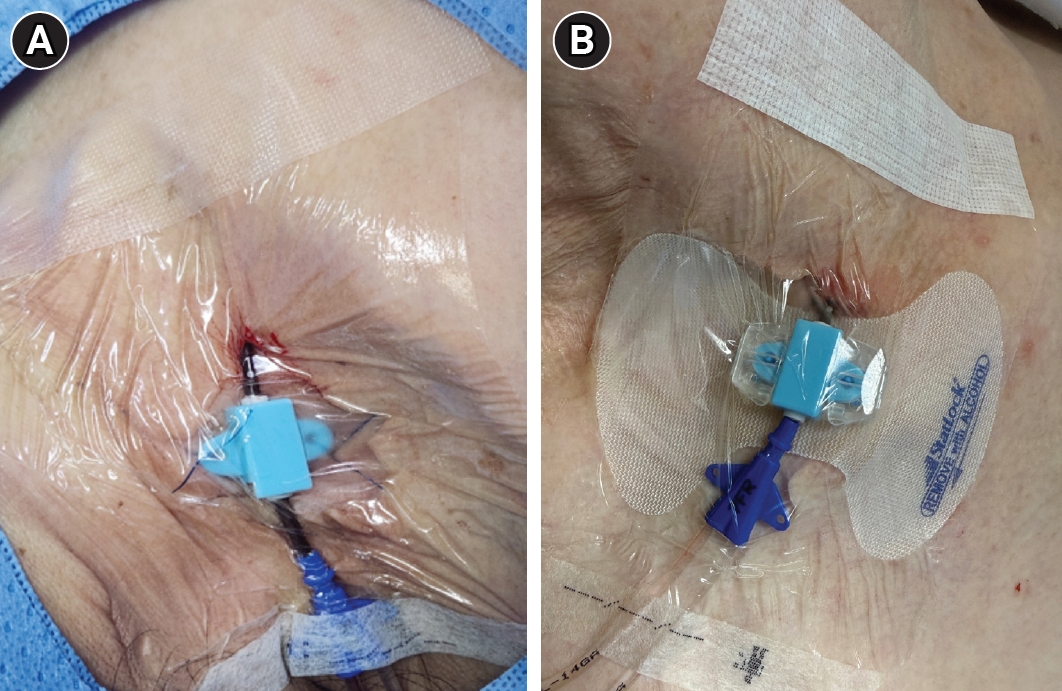
All CICC/FICC insertions were performed under ultrasonographic and fluoroscopic guidance in the angiography suite. Jugular or subclavian veins were preferentially accessed; if unavailable, femoral veins were catheterized. Maximal precautions (including sterile drape coverage from head to toe, surgical hand scrubbing, chlorhexidine antisepsis, and wearing surgical gown and gloves) were applied during catheterization. After CVC placement, catheters in the case group were secured with an SD, whereas those in the control group were sutured with nylon thread on both sides of the catheter hub or clamp (
Fig. 1). The choice of hub or clamp fixation depended on the length of the external portion of the catheter. Dressing using a transparent film (Tegaderm, 3M, St. Paul, MN, USA) was applied after placement, with clear tape additionally applied at both the proximal and distal ends for reinforcement.
Dislocation was defined as any inadvertent catheter movement, including partial withdrawal or complete dislodgement. CLABSI was defined according to the National Healthcare Safety Network as a laboratory-confirmed bloodstream infection not secondary to infection at another body site in a patient with a central line that had been in place for more than two consecutive calendar days [
6].
Descriptive statistics summarized demographic and clinical features of both groups. Continuous variables are expressed as mean ± standard deviation and were compared using the Mann-Whitney U test or independent t-test, as appropriate, while categorical variables are presented as frequencies with percentages and were compared using the chi-square or Fisher's exact test, as appropriate. Dislocation and CLABSI rates per 1,000 catheter-days were calculated for each group and compared using the incidence rate ratio (IRR) estimated by Poisson regression. Absence of overdispersion was confirmed prior to analysis.
Propensity score matching (PSM) was performed using the MatchIt package (R ver. 4.3.2, The R Foundation, Vienna, Austria) with a nearest-neighbor method at a 1:2 (case:control) ratio. Propensity scores were estimated via logistic regression including the following covariates: age, sex, care setting (ICU vs. general ward), clinical indication (surgical vs. medical), access side (right vs. left), use of tissue adhesive, history of prior catheterization, and comorbidities. A caliper width of 0.15 SDs of the logit of the propensity score was applied, with Mahalanobis distance matching additionally used for age and prior catheterization history. Covariate balance after matching was assessed using standardized mean differences (SMD) and visualized with a Love plot; SMD < 0.1 was considered well-balanced, and SMD < 0.25 acceptable. To account for any residual imbalance after PSM, doubly robust estimation was performed by further adjusting in multivariable Cox regression models.
Kaplan-Meier curves were generated and compared using the log-rank test. Univariable and multivariable Cox proportional hazards regression analyses were performed to identify factors associated with dislocation and CLABSI. For the dislocation analysis, dislocation was defined as the event of interest, while catheter removal, death, and end of the study period were treated as censoring events; an analogous censoring scheme was applied for the CLABSI analysis, with CLABSI defined as the event of interest. In cases where a dislodged catheter was replaced, each catheter insertion was treated as an independent episode with a new follow-up period. The proportional hazards assumption was verified using Schoenfeld residual tests, and stratified Cox models were applied if violations were detected. Multivariable model selection was guided by the Akaike information criterion, and the number of events per variable (EPV) was considered to prevent overfitting.
To evaluate robustness to potential institution-level clustering, sensitivity analyses were performed using a mixed-effects Cox model with matched subclass as a random effect and a Cox model with cluster-robust standard errors. The likelihood ratio test (LRT) was used to assess the significance of the random effect. Cumulative incidence functions were estimated and visualized using the Fine-Gray model, and group differences were assessed using Gray's test. Additionally, to assess the influence of vascular access site, sensitivity analyses were repeated after adjusting jugular versus subclavian access, excluding six patients with femoral access due to sparse data.
All analyses were performed in R version 4.3.2 (The R Foundation), with two-sided p-values < 0.05 considered statistically significant.
Results
Patients and PSM
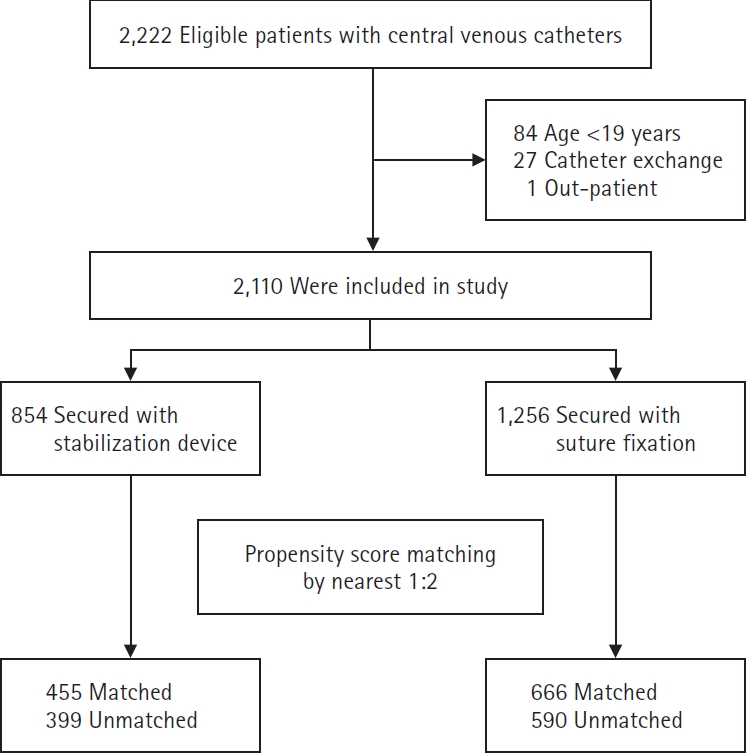
Among 2,222 eligible patients, 2,110 were included in this study (
Fig. 2). CVCs were secured with SDs in 854 patients, whereas 1,256 patients had catheters sutured with nylon. Patient characteristics are presented in
Table 1. Due to institutional differences, such as disease severity, catheterization preference, access site, or dwelling time, significant imbalances were observed between groups. A propensity score–matched dataset was generated, including 1,121 patients (SD group: n = 455, age 60.6 ± 16.5 years, female = 281; SF group: n = 666, age 63.8 ± 15.0 years, female = 368). SMD before and after matching, along with the Love plot, demonstrated balanced matching except for ICU stay (SMD = 0.22) after matching (
Supplementary Table 1,
Supplementary Fig. 1).
Dislocation occurred more frequently in the SD group (23 patients over 3,933 catheter-days) than in the SF group (15 patients over 6,906 catheter-days). The IRR was 2.64 (95% CI, 1.36 to 5.34) using a Poisson regression model. In contrast, CLABSI occurred more frequently in the SF group (31 patients over 6,906 catheter-days) than in the SD group (three patients over 3,933 catheter-days), with an IRR of 0.19 (95% CI, 0.04 to 0.54). No evidence of overdispersion was detected (dispersion = 0.97, p = 0.999).
Kaplan-Meier and Log-Rank Analysis
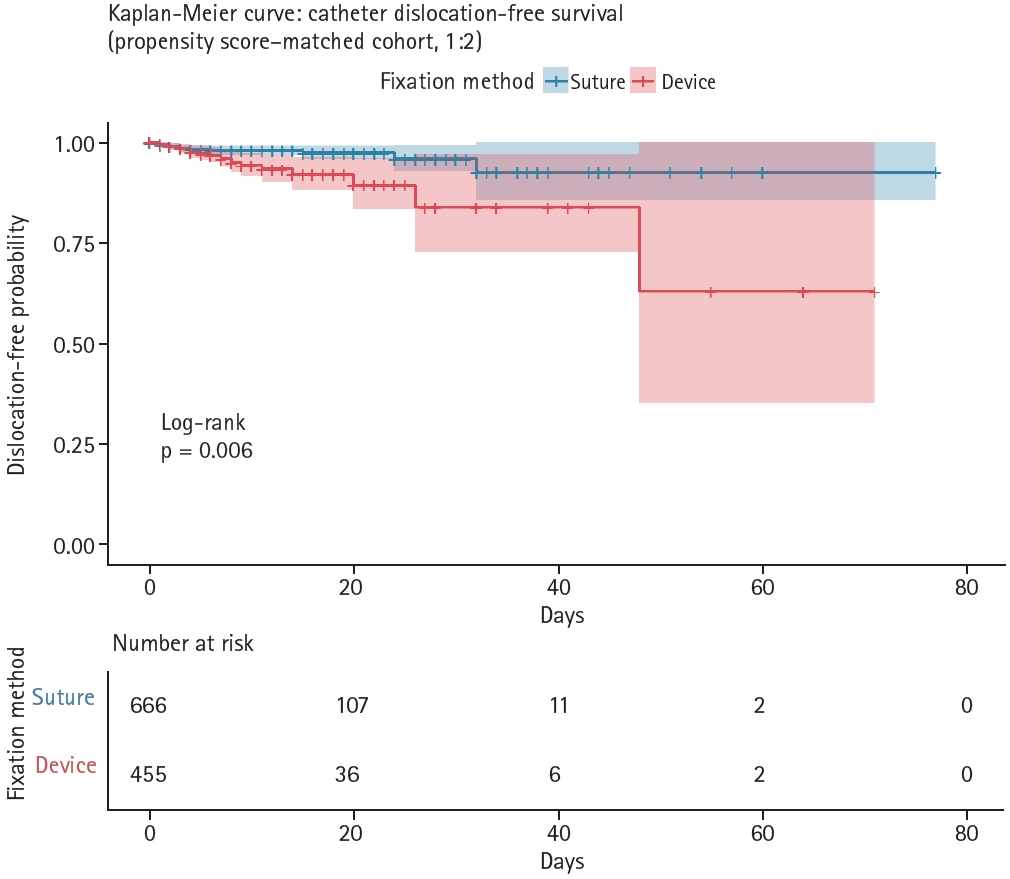
Kaplan-Meier curves demonstrated significant differences in dislocation rates (p = 0.006), with dislocation occurring more frequently in the SD group (
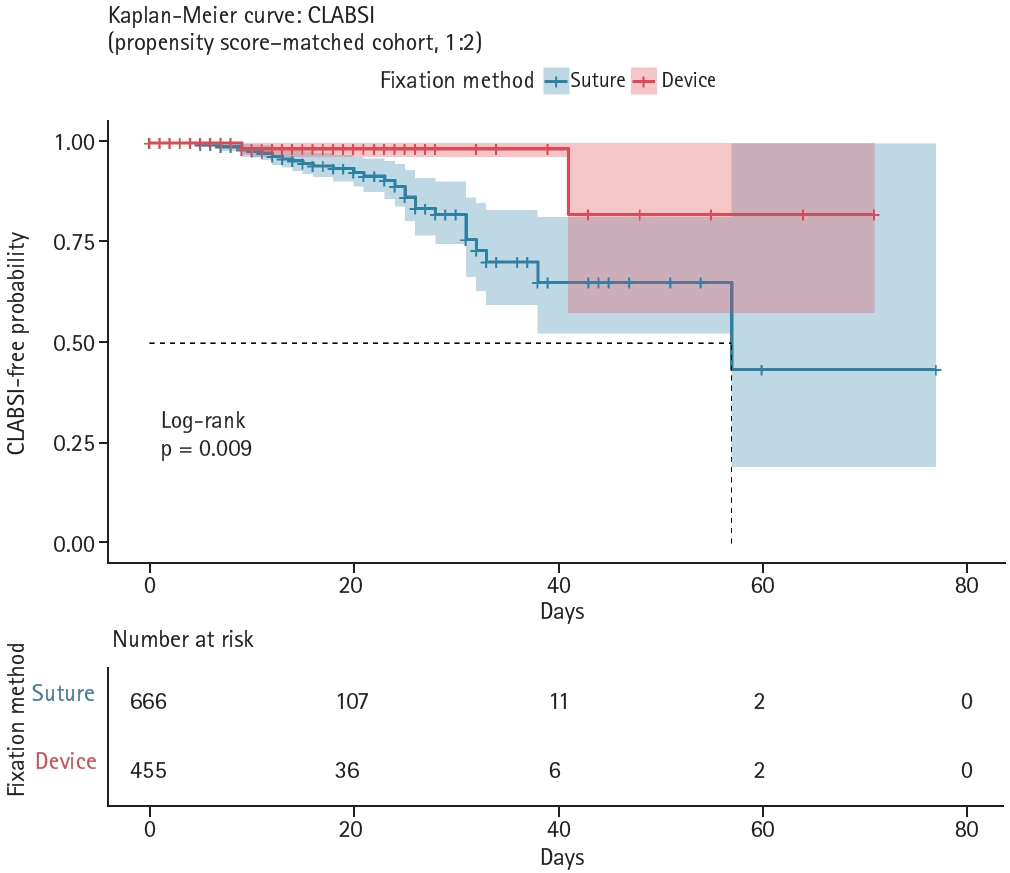
Fig. 3). CLABSI rates were significantly higher in the SF group than in the SD group (p = 0.009) (
Fig. 4).
Univariable analysis indicated that dislocation was more frequent with SD use, older age, and femoral access, and less frequent in patients with surgical indications. In multivariable analysis, stratified by purpose and access site owing to proportional hazards assumption violations, SD use was the only independent predictor of dislocation (adjusted HR, 2.23; 95% CI, 1.11 to 4.48).
Regarding CLABSI, univariable analysis identified protective factors including SD use (HR, 0.24; 95% CI, 0.08 to 0.77), cancer (HR, 0.33; 95% CI, 0.12 to 0.91), and multiple comorbidities (HR, 0.30; 95% CI, 0.13 to 0.70). Significant risk factors included older age (HR, 1.03; 95% CI, 1.01 to 1.06), subclavian access (HR, 2.31; 95% CI, 1.01 to 5.24), and triple-lumen catheter use (HR, 4.00; 95% CI, 1.88 to 8.52). In multivariable analysis, only the use of triple-lumen catheters remained a significant risk factor. Although SD use showed a protective effect in univariable analysis (p = 0.017), this effect was not statistically significant in multivariable analysis (HR, 0.49; 95% CI, 0.13 to 1.82; p = 0.28), likely owing to limited statistical power (low EPV = 4.3). Detailed results of Cox proportional hazards analyses are shown in
Tables 2 and
3. To account for residual imbalance in ICU admission after PSM, doubly robust estimation was performed by additionally adjusting for ICU status in multivariable models; results remained consistent (dislocation: HR, 2.17; 95% CI, 1.10 to 4.29; CLABSI: HR, 0.49; 95% CI, 0.13 to 1.80), supporting the robustness of the primary findings.
To further assess robustness to institution-level clustering, sensitivity analyses were performed using a mixed-effects Cox model with matched subclass as a random effect and a Cox model with cluster-robust standard errors. Both approaches yielded results consistent with the primary analysis, with SD use remaining a significant predictor of dislocation across unadjusted and adjusted models (mixed-effects Cox, adjusted: HR, 3.41; 95% CI, 1.73 to 6.73; p < 0.001; cluster-robust, adjusted: HR, 3.41; 95% CI, 1.77 to 6.57; p < 0.001). The variance of the subclass-level random effect was negligible (variance = 0.0004), and the LRT confirmed no significant clustering within matched subclasses (p > 0.98), indicating that PSM adequately addressed group-level confounding.
A competing risk analysis using the Fine-Gray subdistribution hazard model was additionally performed, treating dislocation as a competing event for CLABSI and vice versa. The subdistribution HR for SD use remained consistent in direction with the primary analysis for both outcomes (CLABSI: subdistribution HR [sHR], 0.19; 95% CI, 0.05 to 0.66; p = 0.009; dislocation: sHR, 3.51; 95% CI, 1.81 to 6.83; p < 0.001), supporting the robustness of the primary findings. Cumulative incidence functions estimated by the Fine-Gray model are presented in
Supplementary Fig. 2.
To further evaluate the potential influence of access site on outcomes, access sites including internal jugular, subclavian, and femoral vein were additionally adjusted for in the Cox models after excluding six patients with femoral access due to sparse data precluding stable estimation. After adjustment, SD remained a significant independent predictor of dislocation (HR, 2.77; 95% CI, 1.33 to 5.77; p = 0.006). For CLABSI, the protective effect of SD was strengthened and approached statistical significance (HR, 0.21; 95% CI, 0.04 to 1.02; p = 0.053), consistent in direction with the primary analysis. The summary of the sensitivity analysis was presented in
Table 4.
Discussion
This multicenter retrospective study compared dislocation and CLABSI rates between SD and SF groups in 1,121 propensity score–matched patients who underwent CICC/FICC. The principal findings were twofold: SD use was associated with a significantly higher risk of catheter dislocation (IRR, 2.64; adjusted HR, 2.23), whereas CLABSI occurred less frequently in the SD group based on incidence rate comparison (IRR, 0.19) and Kaplan-Meier analysis. However, the protective effect of SD on CLABSI did not reach statistical significance in multivariable Cox analysis (adjusted HR, 0.49; p = 0.28). These results suggest a clinical trade-off between dislocation risk and potential infection benefit when selecting a catheter securement method.
Regarding catheter dislocation, SD use independently increased the risk approximately 2.2-fold compared with SF. This finding is mechanistically plausible, as sutures anchor the catheter hub directly to subcutaneous tissue, providing firm resistance against outward traction, whereas SDs rely on adhesive bonding to the skin, which is more susceptible to loosening from moisture, perspiration, and patient movement. An in vitro biomechanical study reported that SF using a finger-trap technique withstood dislodgement forces exceeding 76 N [
7], consistent with our clinical findings. Karpanen et al. [
8] reported a numerically higher rate of unplanned CVC removal in the suture-free group (6%) versus the suture group (2%) in a multicenter randomized feasibility study of 171 patients, although the difference was not statistically significant. Similarly, Mitchell et al.’s CASCADE pilot randomized controlled trial [
9] found the highest central venous access device failure rate in the sutureless securement device (StatLock) group (27.3 per 1,000 catheter-days) among four securement methods in 121 ICU patients, though the study was underpowered. Some smaller studies reported no difference or even lower dislodgement rates with sutureless methods; however, these trials used different device types and enrolled substantially smaller cohorts (n = 100–271) [
2,
3]. Our propensity score–matched analysis of 1,121 patients provides more robust evidence supporting the higher dislocation risk associated with SDs.
The relationship between catheter securement methods and CLABSI is complex. In our study, unadjusted analyses consistently showed a lower CLABSI rate in the SD group: the IRR was 0.19 (95% CI, 0.04 to 0.54), and Kaplan-Meier analysis demonstrated a significant difference (p = 0.009). However, when adjusting for confounders in multivariable Cox regression, the protective effect of SD use was attenuated and no longer statistically significant (HR, 0.49; 95% CI, 0.13 to 1.82; p = 0.28). This attenuation is likely owing to limited statistical power rather than a true absence of effect, as only 34 CLABSI events occurred across both groups, resulting in a low EPV (4.3) in the multivariable model. Cox regression models become unreliable when EPV falls below 10 [
10]. Moreover, the low total event count renders the Kaplan-Meier curves for CLABSI (
Fig. 4) susceptible to instability in later follow-up intervals, where the number of patients at risk diminishes substantially; this uncertainty is compounded by the differential cumulative exposure between groups (SF: 6,906 vs. SD: 3,933 catheter-days; ratio approximately 1.75:1), which should be considered when interpreting the observed curve separation. This issue of low event rates is not unique to our study; prior securement trials have similarly reported few confirmed CLABSI events despite substantial enrollment [
2,
9]. The consistency of the direction and magnitude of the protective signal across multiple analytic approaches, including Poisson regression, Kaplan-Meier analysis, and doubly robust sensitivity analysis (HR, 0.49; 95% CI, 0.13 to 1.82), supports this interpretation. Existing systematic reviews, including a Cochrane review and a recent meta-analysis of 46 studies encompassing 10,054 participants, have similarly found no definitive consensus on the optimal securement method for infection prevention, although sutureless devices appear most promising [
11,
12]. Taken together, our findings suggest a potential protective effect of SDs against CLABSI, but adequately powered prospective studies are needed to confirm this independently.
Several biological mechanisms may explain the potential association between SF and increased CLABSI risk. Sutures create additional percutaneous puncture sites near the catheter exit, each serving as a potential portal for skin microorganisms [
13]; suture material acts as a foreign body promoting biofilm formation and subsequent intravascular migration of colonizing organisms [
4,
8]; and minor bleeding from suture placement produces a nutrient-rich microenvironment that facilitates bacterial proliferation at the catheter exit site [
14]. SDs eliminate these suture-specific risk factors by securing the catheter through adhesive contact alone, without penetrating the skin barrier.
Triple-lumen catheter use was independently associated with CLABSI in our multivariable analysis (HR, 2.93; 95% CI, 1.23 to 6.96), consistent with prior meta-analyses reporting significantly higher infection risks with multilumen catheters (OR, 2.74; 95% CI, 1.84 to 4.07) [
15,
16], likely owing to increased hub manipulation, which amplifies opportunities for intraluminal contamination [
17].
These findings have important clinical implications for catheter securement. In patients at higher infection risk (such as those with prolonged catheterization, immunocompromised status, or triple-lumen catheters), SD use may be preferable despite the higher dislocation risk, given that CLABSI is a serious healthcare-associated infection with an attributable mortality of 12%–25% [
18], whereas catheter dislocation is typically manageable with reinsertion. Conversely, in patients for whom catheter dislocation would be particularly consequential, such as those with limited venous access or receiving critical infusions, SF may remain the more appropriate choice. Strategies to mitigate SD-associated dislocation risk, including concurrent use of tissue adhesive at the exit site or integrated securement dressings, warrant further investigation.
This study has several limitations. First, this was a retrospective secondary analysis of data originally collected for a different purpose (tissue adhesive efficacy), and certain variables (such as dressing change frequency and nursing-to-patient ratio) were not systematically recorded. However, PSM with doubly robust estimation and the consistency of results across multiple analytic methods support the validity of our findings. Second, the SD and SF groups were separated by institution rather than randomized within each institution, introducing potential institutional confounding; observed differences may partly reflect institution-level factors rather than securement method. Although PSM balanced most measured covariates and stratified Cox models addressed residual imbalances, unmeasured confounders cannot be fully excluded. A multicenter randomized controlled trial using both securement methods within each institution would be needed to definitively address this limitation. Third, the low CLABSI event rate (34 events across both groups; EPV = 4.3) limited the statistical power of the multivariable analysis. While the protective signal was consistent across all analytic approaches, the study was underpowered to confirm the independent effect of SD use on CLABSI. Notably, however, the Fine-Gray competing risk model—which accounts for dislocation as a competing event—yielded a statistically significant protective effect of SD on CLABSI (sHR, 0.19; 95% CI, 0.05 to 0.66; p = 0.009), and a borderline significant effect was similarly observed after additional adjustment for vascular access site (HR, 0.21; 95% CI, 0.04 to 1.02; p = 0.053). These findings suggest that the protective effect of SD on CLABSI may be real but requires confirmation in larger, adequately powered studies. These findings apply specifically to adhesive-pad SDs, as exemplified by StatLock (BD), and should not be generalized to other CVC securement modalities (including subcutaneous anchor securement systems, tissue adhesives, and integrated securement dressings) without further validation. Lastly, vascular access site (internal jugular, subclavian, and femoral) was not included as a PSM covariate due to strong institution-level preferences, resulting in substantial residual imbalance after matching (SMD, 0.65–0.66). Although a sensitivity analysis adjusting for access site yielded consistent results, the potential influence of this residual imbalance on effect estimates cannot be entirely excluded. Future studies with adequate sample sizes, informed by the effect sizes observed herein, are warranted.
Despite these limitations, the strengths of this study include a large sample size, multicenter design, rigorous statistical methodology with multiple complementary analytic approaches, and clinically relevant dual endpoints encompassing both dislocation and CLABSI.
In conclusion, this multicenter propensity score–matched study demonstrated that catheter SDs were associated with a higher rate of dislocation compared with SF, while multiple analytic approaches consistently suggested a lower CLABSI rate with SD use, which did not reach statistical significance in the primary multivariable analysis but became significant when dislocation was modeled as a competing event.
Conflict of interest
Dong Jae Shim, contributing editor of the Korean Journal of Interventional Radiology, was not involved in the editorial evaluation or decision to publish this article. All remaining authors have declared no conflicts of interest.
Funding
None.
Acknowledgments
This manuscript is based on the first author (Jung Ui Hong)’s doctoral dissertation at Inha University.
Author contributions
Conceptualization: DJS. Data curation: YK, JHL, DJS. Formal analysis: DJS. Investigation: DJS. Methodology: YK, JHL, DJS. Project administration: DJS. Resources: DJS. Software: DJS. Supervision: DJS. Validation: DJS. Visualization: DJS. Writing - original draft: JUH, DJS. Writing - review & editing: JUH, DJS.
Data availability statement
The datasets generated or analyzed during the study are available from the corresponding author on reasonable request.
Supplementary material
Supplementary Fig. 2.
Cumulative incidence of central line-associated bloodstream infection (CLABSI) and dislocation by securement method after propensity score matching. Cumulative incidence functions were estimated using the Fine-Gray subdistribution hazard model, with dislocation treated as a competing event for CLABSI (B) and CLABSI treated as a competing event for dislocation (A). Group differences were assessed using Gray's test.
Fig. 1.Representative photographs of catheter securement methods. (A) Suture fixation. (B) Adhesive-pad stabilization device.
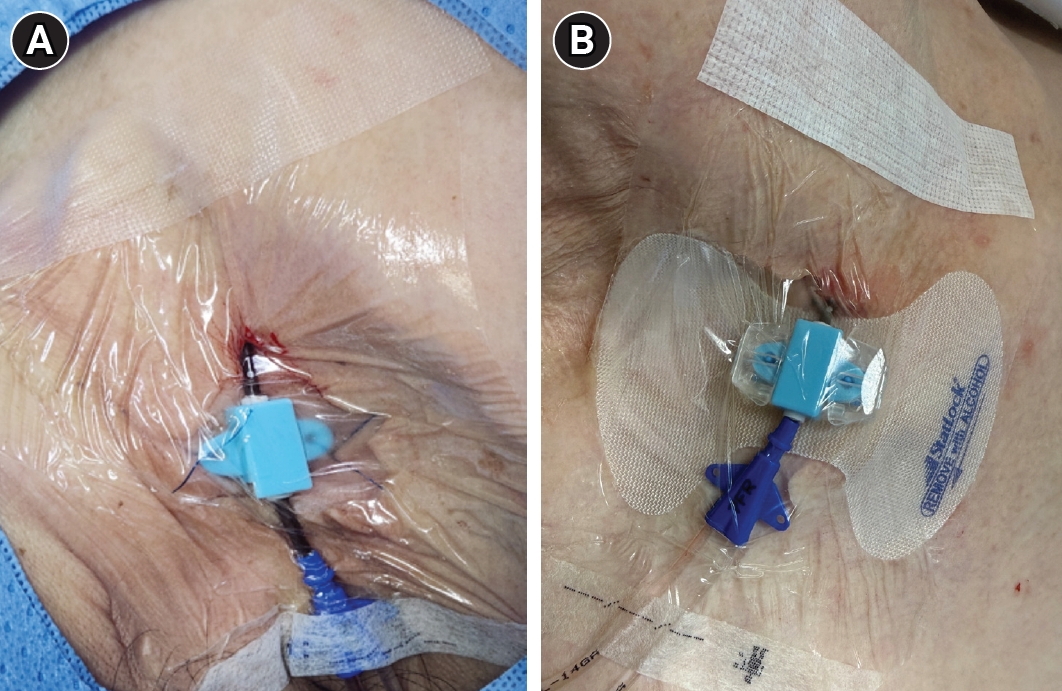
Fig. 2.Patient selection flowchart.
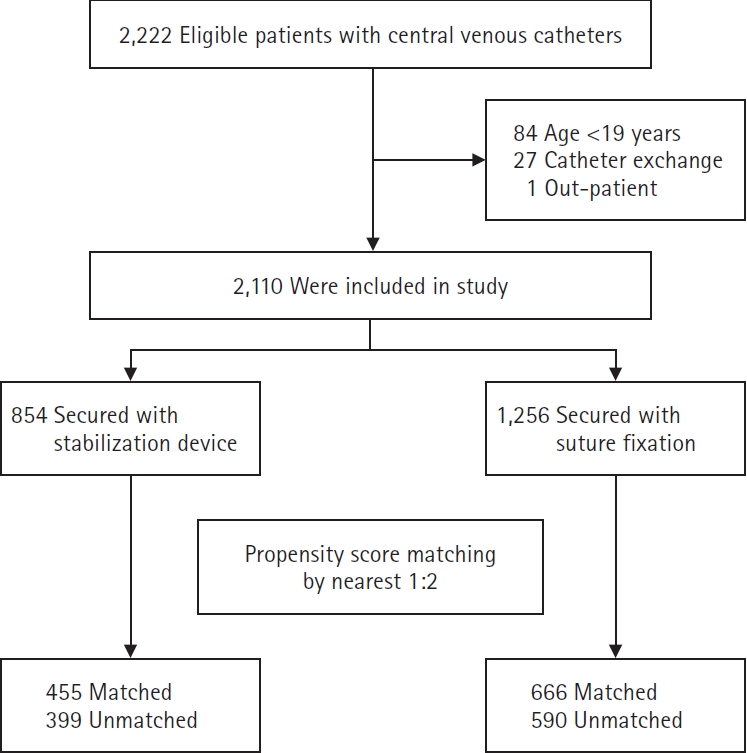
Fig. 3.Kaplan-Meier survival curves for central venous catheter dislocation according to fixation method.
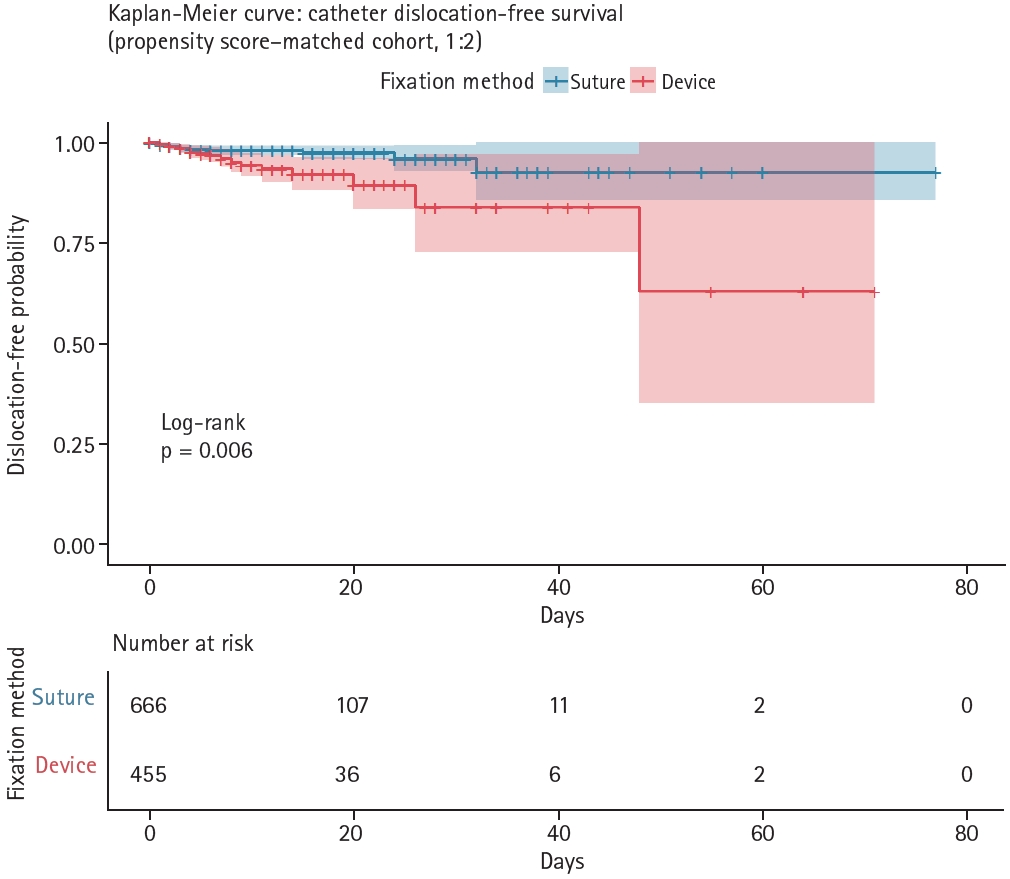
Fig. 4.Kaplan-Meier survival curves for central line–associated bloodstream infection (CLABSI) according to fixation method. Note: Interpretation should consider the low total event count (n = 34), diminishing at-risk numbers in later intervals, and the differential cumulative catheter-days between groups (suture fixation 6,906 vs. stabilization device, 3,933).
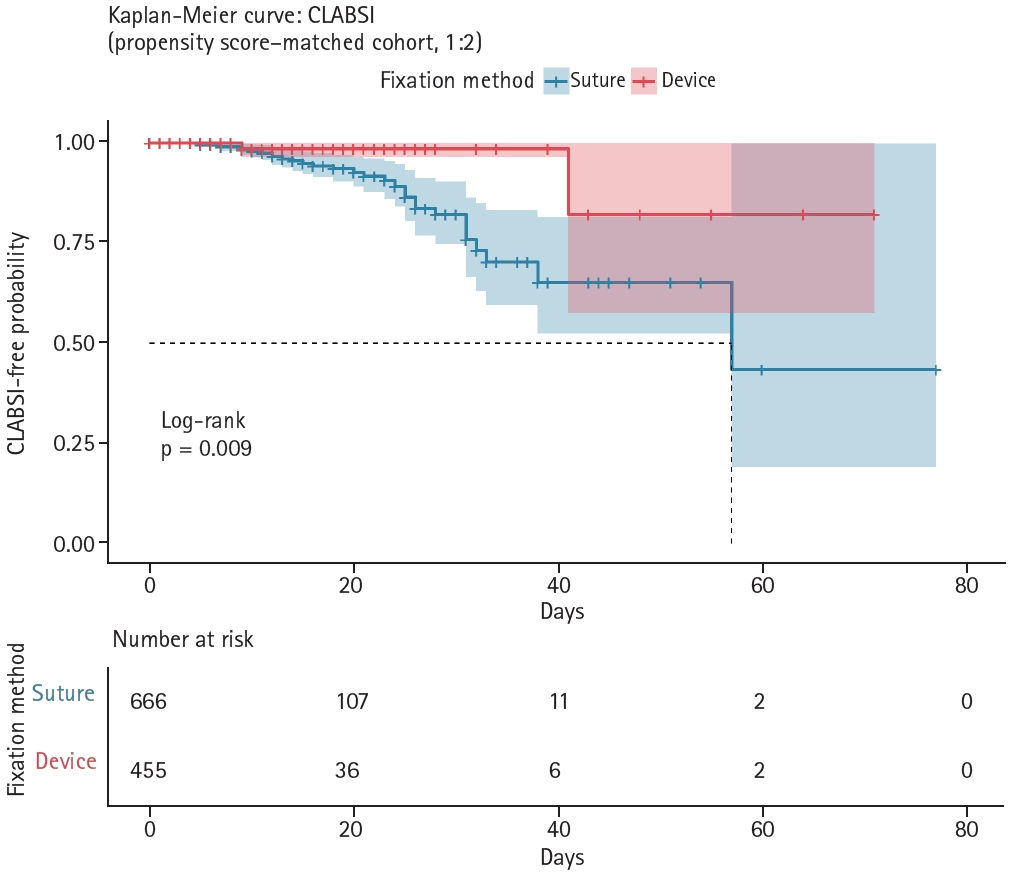
Table 1.
Table 1.
|
Overall |
Suture |
Device |
p-value |
|
No. |
2,110 |
1,256 |
854 |
|
|
Sex |
|
|
|
<0.001 |
|
Female |
1,045 (49.5) |
674 (53.7) |
371 (43.4) |
|
|
Male |
1,065 (50.5) |
582 (46.3) |
483 (56.6) |
|
|
Age (years) |
|
61 (49–71) |
63 (53–73) |
<0.001 |
|
Care unit |
|
|
|
<0.001 |
|
General wards |
1,515 (71.8) |
725 (57.7) |
790 (92.5) |
|
|
ICU |
595 (28.2) |
531 (42.3) |
64 (7.5) |
|
|
Clinical indication |
|
|
|
<0.001 |
|
Medical |
1,229 (58.2) |
1,005 (80.0) |
224 (26.2) |
|
|
Surgical |
881 (41.8) |
251 (20.0) |
630 (73.8) |
|
|
Access side |
|
|
|
<0.001 |
|
Left |
1,956 (92.7) |
1,128 (89.8) |
828 (97.0) |
|
|
Right |
154 (7.3) |
128 (10.2) |
26 (3.0) |
|
|
Access site |
|
|
|
<0.001 |
|
Jugular |
978 (46.4) |
213 (17.0) |
765 (89.6) |
|
|
Subclavian |
1,126 (53.4) |
1,043 (83.0) |
83 (9.7) |
|
|
Femoral |
6 (0.3) |
0 (0) |
6 (0.7) |
|
|
Use of tissue adhesive |
|
|
|
>0.999 |
|
None |
1,049 (49.7) |
624 (49.7) |
425 (49.8) |
|
|
Tissue adhesive |
1,061 (50.3) |
632 (50.3) |
429 (50.2) |
|
|
Comorbidities |
|
|
|
<0.001 |
|
None |
465 (22.0) |
351 (27.9) |
114 (13.3) |
|
|
DM |
202 (9.6) |
153 (12.2) |
49 (5.7) |
|
|
Cancer |
776 (36.8) |
333 (26.5) |
443 (51.9) |
|
|
Immunocompromised |
15 (0.7) |
13 (1.0) |
2 (0.2) |
|
|
ESRD |
54 (2.6) |
24 (1.9) |
30 (3.5) |
|
|
Multi-comorbidities |
598 (28.3) |
382 (30.4) |
216 (25.3) |
|
|
No. of prior catheterizations |
|
1 (1–2) |
1 (1–1) |
<0.001 |
|
Dwelling time (days) |
|
10 (4–19) |
6 (4–8) |
<0.001 |
|
Dislocation |
|
|
|
0.011 |
|
No |
2,059 (97.6) |
1,235 (98.3) |
824 (96.5) |
|
|
Yes |
51 (2.4) |
21 (1.7) |
30 (3.5) |
|
Table 2.Univariable and multivariable Cox proportional hazards analysis for central venous catheter dislocation
Table 2.
|
Variable |
Univariable |
Multivariable |
|
HR (95% CI) |
p-value |
HR (95% CI) |
p-value |
|
Treatment |
|
Suture |
Reference |
- |
Reference |
- |
|
Device |
2.374 (1.203–4.685) |
0.013 |
2.232 (1.112–4.477) |
0.024 |
|
Demographics |
|
Age (per year) |
1.028 (1.004–1.053) |
0.020 |
1.009 (0.981–1.037) |
0.532 |
|
Male sex |
1.524 (0.765–3.036) |
0.231 |
- |
- |
|
Clinical characteristics |
|
ICU admission |
0.897 (0.408–1.971) |
0.787 |
- |
- |
|
Purpose: surgical |
0.139 (0.041–0.476) |
0.002 |
Stratified |
- |
|
Side: left |
1.256 (0.448–3.523) |
0.665 |
- |
- |
|
Tissue adhesive fixation |
0.840 (0.435–1.622) |
0.604 |
- |
- |
|
Prior catheterization (n) |
0.679 (0.284–1.621) |
0.383 |
- |
- |
|
Access site (ref: jugular) |
|
Subclavian |
0.561 (0.281–1.120) |
0.101 |
Stratified |
- |
|
Femoral |
6.391 (1.030–39.670) |
0.047 |
Stratified |
- |
|
Lumen |
|
3-Lumen |
0.995 (0.432–2.292) |
0.991 |
- |
- |
|
Comorbidity (ref: none) |
|
DM |
1.332 (0.410–4.330) |
0.633 |
- |
- |
|
Cancer |
0.363 (0.117–1.125) |
0.079 |
- |
- |
|
ESRD |
1.283 (0.249–6.613) |
0.766 |
- |
- |
|
Multicomorbidities |
1.463 (0.594–3.604) |
0.408 |
- |
- |
Table 3.Univariable and multivariable Cox proportional hazards analysis for CLABSI
Table 3.
|
Variable |
Univariable |
Multivariable |
|
HR (95% CI) |
p-value |
HR (95% CI) |
p-value |
|
Treatment |
|
Suture |
Reference |
- |
Reference |
- |
|
Device |
0.242 (0.075–0.774) |
0.017 |
0.486 (0.130–1.822) |
0.285 |
|
Demographics |
|
Age (per year) |
1.034 (1.006–1.064) |
0.018 |
- |
- |
|
Male sex |
0.595 (0.301–1.176) |
0.135 |
- |
- |
|
Clinical characteristics |
|
ICU admission |
1.849 (0.951–3.596) |
0.070 |
- |
- |
|
Purpose: surgical |
0.634 (0.127–3.151) |
0.577 |
- |
- |
|
Side: left |
1.388 (0.596–3.234) |
0.447 |
- |
- |
|
Tissue adhesive (glue) |
0.494 (0.232–1.051) |
0.067 |
0.515 (0.240–1.106) |
0.089 |
|
Prior catheterization |
1.125 (0.728–1.739) |
0.597 |
- |
- |
|
Access site (ref: jugular/femoral) |
|
Subclavian |
2.305 (1.014–5.240) |
0.046 |
- |
- |
|
Lumen |
|
3-Lumen |
4.000 (1.878–8.519) |
<0.001 |
2.928 (1.232–6.961) |
0.015 |
|
Comorbidity (ref: none) |
|
DM |
0.237 (0.043–1.306) |
0.098 |
- |
- |
|
Cancer |
0.333 (0.122–0.909) |
0.032 |
- |
- |
|
Immunocompromised |
0.541 (0.171–1.710) |
0.296 |
- |
- |
|
ESRD |
0.374 (0.081–1.718) |
0.206 |
- |
- |
|
Multicomorbidities |
0.297 (0.126–0.701) |
0.006 |
- |
- |
Table 4.Summary of sensitivity analyses for dislocation and CLABSI
Table 4.
|
Analysis |
Dislocation HR (95% CI) |
p-value |
CLABSI HR (95% CI) |
p-value |
|
Primary analysis |
|
Multivariable Cox (PSM, doubly robust) |
2.23 (1.11–4.48) |
0.024a
|
0.49 (0.13–1.82) |
0.285 |
|
Institution-level clustering |
|
Mixed-effects Cox (random effect: matched subclass), unadjusted |
2.46 (1.27–4.75) |
0.007 |
- |
- |
|
Mixed-effects Cox (random effect: matched subclass), adjusted |
3.41 (1.73–6.73) |
<0.001 |
- |
- |
|
Cox with cluster-robust SE (cluster: matched subclass), unadjusted |
2.46 (1.27–4.77) |
0.008 |
- |
- |
|
Cox with cluster-robust SE (cluster: matched subclass), adjusted |
3.41 (1.77–6.57) |
<0.001 |
- |
- |
|
Competing risk analysis |
|
Fine-Gray subdistribution hazard model (unadjusted) |
3.51 (1.81–6.83) |
<0.001 |
0.19 (0.05–0.66) |
0.009 |
|
Access site adjustment |
|
Cox with access site adjustment (femoral access excluded, n=6) |
2.77 (1.33–5.77) |
0.006 |
0.21 (0.04–1.02) |
0.053 |
References
- 1. Kehagias E, Galanakis N, Tsetis D. Central venous catheters: which, when and how. Br J Radiol. 2023;96:20220894. https://doi.org/10.1259/bjr.20220894
- 2. Chen Y, Chen X, Jin X, Zeng X, Cao X, Zhao L. Compare the safety and efficacy of integrated securement device versus suture securement for centrally inserted central venous catheters: a prospective cohort study. Sci Rep. 2025;15:34907. https://doi.org/10.1038/s41598-025-18777-2
- 3. Molina-Mazon CS, Martin-Cerezo X, Domene-Nieves de la Vega G, Asensio-Flores S, Adamuz-Tomas J. Comparative study on fixation of central venous catheter by suture versus adhesive device. Enferm Intensiva (Engl Ed). 2018;29:103-112. https://doi.org/10.1016/j.enfi.2017.10.004
- 4. Nickel B, Gorski L, Kleidon T, Kyes A, DeVries M, Keogh S, et al. Infusion therapy standards of practice, 9th edition. J Infus Nurs. 2024;47(1S):S1-S285. https://doi.org/10.1097/NAN.0000000000000532
- 5. Kwon Y, Shim DJ, Lee JH, Kim D, Baek SH, Kim J, et al. Effect of tissue adhesive application on central line-associated bloodstream infections: a multi-centre retrospective study. J Hosp Infect. 2025;162:153-159. https://doi.org/10.1016/j.jhin.2025.04.030
- 6. Centers for Disease Control and Prevention. Bloodstream infection event (central line-associated bloodstream infection and non-central line associated bloodstream infection). https://www.cdc.gov/nhsn/pdfs/pscmanual/4psc_clabscurrent.pdf. Published January 2026. Accessed March 2026.
- 7. Struck MF, Friedrich L, Schleifenbaum S, Kirsten H, Schummer W, Winkler BE. Effectiveness of different central venous catheter fixation suture techniques: an in vitro crossover study. PLoS One. 2019;14:e0222463. https://doi.org/10.1371/journal.pone.0222463
- 8. Karpanen TJ, Casey AL, Whitehouse T, Timsit JF, Mimoz O, Palomar M, et al. A clinical evaluation of two central venous catheter stabilization systems. Ann Intensive Care. 2019;9:49. https://doi.org/10.1186/s13613-019-0519-6
- 9. Mitchell ML, Ullman AJ, Takashima M, Davis C, Mihala G, Powell M, et al. Central venous access device securement and dressing effectiveness: the CASCADE pilot randomised controlled trial in the adult intensive care. Aust Crit Care. 2020;33:441-451. https://doi.org/10.1016/j.aucc.2019.10.002
- 10. Peduzzi P, Concato J, Kemper E, Holford TR, Feinstein AR. A simulation study of the number of events per variable in logistic regression analysis. J Clin Epidemiol. 1996;49:1373-1379. https://doi.org/10.1016/s0895-4356(96)00236-3
- 11. Ullman AJ, Cooke ML, Mitchell M, Lin F, New K, Long DA, et al. Dressings and securement devices for central venous catheters (CVC). Cochrane Database Syst Rev. 2015;2015:CD010367. https://doi.org/10.1002/14651858.CD010367.pub2
- 12. Xu H, Hyun A, Mihala G, Rickard CM, Cooke ML, Lin F, et al. The effectiveness of dressings and securement devices to prevent central venous catheter-associated complications: a systematic review and meta-analysis. Int J Nurs Stud. 2024;149:104620. https://doi.org/10.1016/j.ijnurstu.2023.104620
- 13. Frey AM, Schears GJ. Why are we stuck on tape and suture? A review of catheter securement devices. J Infus Nurs. 2006;29:34-38. https://doi.org/10.1097/00129804-200601000-00007
- 14. Murga R, Miller JM, Donlan RM. Biofilm formation by gram-negative bacteria on central venous catheter connectors: effect of conditioning films in a laboratory model. J Clin Microbiol. 2001;39:2294-2297. https://doi.org/10.1128/JCM.39.6.2294-2297.2001
- 15. Lafuente Cabrero E, Terradas Robledo R, Civit Cunado A, Garcia Sardelli D, Hidalgo Lopez C, Giro Formatger D, et al. Risk factors of catheter-associated bloodstream infection: systematic review and meta-analysis. PLoS One. 2023;18:e0282290. https://doi.org/10.1371/journal.pone.0282290
- 16. Templeton A, Schlegel M, Fleisch F, Rettenmund G, Schobi B, Henz S, et al. Multilumen central venous catheters increase risk for catheter-related bloodstream infection: prospective surveillance study. Infection. 2008;36:322-327. https://doi.org/10.1007/s15010-008-7314-x
- 17. O'Grady NP, Alexander M, Dellinger EP, Gerberding JL, Heard SO, Maki DG, et al. Guidelines for the prevention of intravascular catheter-related infections. Infect Control Hosp Epidemiol. 2002;23:759-769. https://doi.org/10.1086/502007
- 18. Centers for Disease Control and Prevention (CDC). Vital signs: central line-associated blood stream infections–United States, 2001, 2008, and 2009. MMWR Morb Mortal Wkly Rep. 2011;60:243-248.